Sunday, 29 March 2026

Would the real Joseph Cordell please stand up?

I'm loving being able to combine intel from sites like MyHeritage, along with AI platforms such as ChatGPT (my current favourite) to help me decipher who the unnamed images could actually be of. These images have come from a variety of sources, usually family trees that I have connected with on Ancestry. 


Image A: This fellow is a Cordell family member, but nobody seems to know exactly which Cordell he is. His facial features do look like the man in Image B, except for the hairline. Maybe they're brothers? AI tells me that his tie is typical of the 1890s, being narrow and neatly tied. His soft and slightly textured lounge jacket was increasingly common post-1885. The boutonniere was very fashionable in 1890s studio portraits. The style of the moustache indicates a classic late-Victorian mode, 1885-1900. An oval vignette on mount was extremely common in cabinet cards of the 1890s. The most likely date range for this photo is 1892-1896. 

Image A
Image B

Image B:

Many people have attached this image to the profile of Joseph Chidley CORDELL. He was born in Bermondsey, London in 1800, made various sea voyages to Australia as ship's crew, and married Elizabeth PITCHER in Launceston, Tasmania, in 1825. Together they had 10 children, and I'm descended from their youngest, Martha Ann. He was a river pilot along the Tamar, until his move to Victoria, where he died at the Ararat Asylum in 1868. Joseph's brother, Robert CORDELL (1811-1843), also came to Tasmania, but I don't think these are the men pictured above. Image B is from the personal collection of the late Alan Gill CORDELL (1928-2016) and appears in the anthology On the Tide: stories of the Tamar, edited by Peter Richardson, labelled as being of Joseph Cordell.

AI tells me that this image is a typical studio portrait, like a late 19th-century cabinet card rather than an earlier daguerrotype or ambrotype. The high, stiff collar and patterned tie/cravat are consistent with 1880-1890s fashion. The jacket lapels and tailoring also align with that period. Having a neatly trimmed moustache without a beard became especially common in the 1880s-1890s. It is suggested that this image was probably taken between 1885-1900. Unfortunately, the studio name is illegible.

As Joseph died in 1868, this image is highly unlikely to be of him. Say this man is aged 40, and the photo was taken in the middle of the range, 1892, giving him an estimated DOB of 1850. While Joseph did have a son born in 1847, James Charles CORDELL, he died at age 25, so this can't be him. I believe that the images are of Joseph's grandsons, of whom there were many. To be in Alan Cordell's personal collection, it may well have come from his direct line. Alan's great-grandfather was Joseph and Elizabeth's eldest child, John Henry CORDELL (1826-1898). With his wife, Mary HUBBARD, John had seven children, and all but two were sons. These boys were born between 1847 and 1867, making them potential candidates to be the dapper good-looking men in Images A & B.

If anyone recognises who these men actually are, please let me know!


Image C

Image C:

This gorgeous photo is most likely dated in the early 1890s. His three-piece suit with waistcoat and watch chain indicate a date of 1885-1900. Having a short, neat moustache with no beard was common around 1885-1900. His trousers being made of a more lightweight fabric than his jacket was fashionable in the same era. Holding his bowler-style hat in his hand was very typical in portraits of urban men around this time. The woman's high neckline with ruffles was classic late 1880s to early 1890s. A very fitted bodice with strong waist shaping was a pre-1895 silhouette. Also pointing to this date range was the fact that the sleeves were not yet of the leg-of-mutton style. Having a bustle was also popular there, and AI has used her clothing as the strongest dating clue from the image. 

The earliest date estimated is c.1887, the latest c.1895, with the sweet spot being 1890-1893. Alan's grandparents, George Basey CORDELL and Kate Ellen KITTO married in Launceston, Tasmania in 1889, so this could well be them. I think I'll assign this photo to them in my public Ancestry tree and see if I get any comments refuting it. He has a very similar hairline to my chap in Image A, so my money is on them being the same guy.

Image D

Image D:

Here AI is using the clothing to diagnose a date range of 1893-1896. This is based on the very puffy sleeve style, a high collar with fitted neckband, and a decorative front, including applied round motifs and a central brooch/clasp. Her hair has a centre part and is pulled tightly back, which was fashionable before the looser Edwardian fullness of the 1900s. AI is suggesting to me that it is the same woman as in Image C, just with a different hairstyle. I'm not convinced. I think they have different chin shapes. I'm reluctant to ascribe the image to being Kate Cordell nee Kitto. If it is Kate, and Image A is George, maybe they had studio portraits done a few years after their marriage.


Images E1 & E2:

Finally, I used ChatGPT to enhance this image, to change it from being quite orange, to being more sepia-toned. 
Image E1
Image E2

This image was most likely taken in the mid-late 1860s. AI tells me that having a full beard suggests a 1855-1870 date range, whereas the very long "patriarch" type of beards were popular after that. He is wearing a short fitted jacket with narrow lapels, typical of the 1860s. His visible waistcoat and high fastening also align with that period. High-waisted and fairly straight trousers also align with that period. 

Joseph CORDELL was admitted firstly to Collingwood Asylum and then Yarra Bend Asylum in Victoria on 21 Dec 1867, and a month later was transferred to the newly built Ararat Asylum where he died from cancer on 6 Dec 1868. His death certificate records him as being 50 years of age, but he was actually 68. The Superintendent of the asylum was the registered informant, so they may have known little biographical detail about him. 

The timing aligns for this image to be of "my" Joseph. He certainly looks to be in his 60s. If anyone knows for sure that it's NOT my Joseph, please get in touch, but for now I'm going to claim him. 

Friday, 13 September 2024

Down t’ Pit - article about our Hunter Valley mining ancestors for the Newcastle Family History Society Journal Sep 2024.

 My father is from a long line of coal miners, strecthing back at least to the early 1800s. His COLLINS family emigrated from Worsley, Lancashire, England to Plattsberg, near Wallsend, arriving in Sydney in 1841 on the ‘Adam Lodge’. Many men in the COLLINS family worked in coal mines around Wallsend, including Thomas, his son James, & James’ foster son Andrew COLLINS (my great-grandfather).

Andrew and his wife Rosanna KING moved from Plattsburg to Cessnock with their young family in 1915 to work at mines in that area. By the time their eldest son , my grandfather Andy, was 16 he was working with his father at the Bellbird Colliery south-west of Cessnock. 

The family story has it that Andrew and Andy were offered “a doubler” (working a double shift) on Saturday 1 September 1923 but they declined the extra time as there was a family event that evening. They finished work at 1pm and as was their routine, went straight to Peden’s Pub in Cessnock to wash the coal dust from their throats. As they walked in Mr Peden said to them, “What are you boys doing here? Your pit’s just exploded.” They had narrowly missed being part of the Bellbird Mine Disaster, which had its 100-year anniversary last September. There is a monument in the nearby Memorial Park to commemorate the men who were lost or injured on that fateful day. There had been a fire and explosion at the Bellbird Colliery where 20 men and their horses died from inhaling the gases which caused the explosion. A Mine Manager who ran in to help carry men out also lost his life. 15 bodies were brought to the surface before it was considered too dangerous to continue. The mine was then bricked up to allow the fires to burn themselves out, entombing the remaining men who would have already perished. Newspaper articles and the memorial differ in their total numbers of those men who died.

 https://monumentaustralia.org.au/themes/disaster/industrial/display/20293-bellbird-mining-disaster


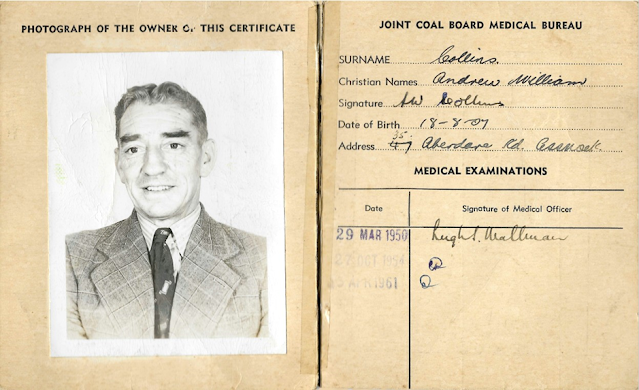
In August 1927 a Joint Coal Board Medical Bureau was established to help guard the health of people working in the coal mining industry. There were offices at Newcastle, Cessnock, Wollongong and Lithgow. Workers were given an initial examination, with check examinations at two or three yearly intervals. I have my grandfather’s Bureau card (below), where he was photographed looking very dapper in a suit and tie. The card is around postcard size.


My father, Gerald Collins, also continued the tradition, working at Chain Valley Colliery,  Vales Point.My enduring memory of my father’s time working there was his “crib tin” (a metal lunch box) with union stickers all over it which always smelled of Minties. There was an empty Nescafé coffee jar in there that Mum kept topped up with the lolly. When Dad came home from work we would be allowed to have a Mintie if we had been well-behaved and then the crib tin was then be stored on top of the hot water system in a cupboard that we couldn’t reach. These tins were made onsite for each man by the boilermakers. This example is far shinier than Dad’s ever was.


Monday, 4 September 2023

Ivy was disinherited for marrying a Catholic. Or was she?


Edward and Ivy's wedding portrait taken on 27 November 1907


Just like mitochondrial DNA, a lot of family history stories are carried down the women’s line, both the facts and the myths that may be more economical with the truth. When the women in my family get together they usually exchange a lot of information and talk about different topics than the men in the family generally do. That’s how I came to hear the tale from my aunty, who heard it from her aunties, that my great-grandmother, Ivy Lorne Cruickshank, had been disinherited by her father because she married a Catholic. The legend also included that Ivy’s sisters had banded together to give Ivy her fair share after their father had died. 

In 1879 Ivy Lorne Cruickshank was born on a rural property called ‘Walloo Station’ near the renowned equestrian area of Scone, New South Wales. In a happy coincidence, we share a birthday, 7th August but we were born 89 years apart. Seven siblings followed over the next 18 years: Florence, Leslie, Ida, Ruby, Sidney, Archibald, and Cyril, with both Florence and Archie dying young. Their father, John Cruickshank, was a horse breeder and known to be quite a tyrant. Ivy’s mother, Elizabeth Lorne Cruickshank née Brackenreg, gave music lessons and was the organist for the Church of England at Maitland. Ivy was brought up in a wealthy and devout family.  

When Ivy and Edward James O’Neill the Cruickshank and O’Neill families were living on neighbouring properties at Bellbird. The Cruickshanks were graziers and the O’Neills were running a Wine Shop which also doubled as a poteen outlet (poteen is an illicit spirit, often distilled from potatoes). Maybe John was anti-Catholic, or maybe he just didn’t like his eldest daughter being courted by the youngest son of an Irish moonshiner.

Ivy was aged 29 before she and Edward (known as Ned) married on 27 November 1907, circumventing the need for John’s approval of the union. The happy event was held at St Mary’s Roman Catholic Church in Newcastle, with the witnesses being two of Ned’s cousins, Alphonsus and Agnes Kerr6. To be married inside the Catholic Church Ivy would have converted from the Church of England to Catholicism. Ivy and Ned’s first child of seven was born a respectable eleven months later. I wonder if John and Elizabeth were part of these celebrations. Presumably incensed, John wrote his will just five days after the wedding on 5th December 1907. This will contained several country estates and provision of £200 per year to Elizabeth. 

Five years later John died of heat apoplexy (now known as sunstroke. He left a considerable-sized property to his son Leslie, another to son Sidney, and one to son Cyril. John left the residue of his real and personal estate to his sons listed as Leslie, Sidney, and Cyril, and daughters Ida and Ruby8. Ivy was the only living child not mentioned at all. 

It seemed that the family myth about Ivy being disinherited was true after all. 

In December 1940, nine years before her death on 2nd September 1949  Elizabeth wrote her will where she redressed the inequity of the past. Ivy was included as a beneficiary of Elizabeth’s will, and she was nominated as an Executrix, along with her sister Ruby, and Ida’s husband Wilmot Bailey as co-executors. Elizabeth divided her full estate between her children, leaving £200 to Leslie, several blocks of land to Sidney’s wife Maude, and the residue divided equally between Ivy, Ida, and Ruby. 

Unfortunately, Ivy died from breast cancer on Christmas Eve 1947 at Cessnock, New South Wales. She pre-deceased her mother by almost two years. Elizabeth did not change her will to reflect this. 

It looks like in the final analysis, the family myth was only partially true. It was correct as far as John’s death was concerned, but Elizabeth went to great lengths to fairly distribute her estate when her time came. 

This tale of a 111-year-old family myth shows that families don’t forget stories if they are kept alive by their descendants. As family historians we are striving to find the truths behind a myth and to test if it is correct or not. We love to find out about our ancestor’s lives and transgressions, whether they want to be remembered that way or not.


[1] "The Maitland Daily Mercury (NSW : 1894 - 1939)." 1903. "CESSNOCK." June 24, p. 6. Accessed May 31, 2023. http://nla.gov.au/nla.news-article126240028.

[2] "Government Gazette Notices." Government Gazette of the State of New South Wales (Sydney, NSW : 1901 - 2001). 1901. November 26, p. 9153. Accessed May 31, 2023. http://nla.gov.au/nla.news-article226390617.

[3] New South Wales. Marriage certificate (certified copy) for Edward James O'Neill and Ivy Lorne Cruckshank, married November 27, 1907. Registration number 1907/11222. NSW Registry of Births Deaths & Marriages, Chippendale.

[4] NSW Government. Registry of Births, Deaths and Marriages. "Online Birth Indexes." Thomas Augustine O'Neill. Registration number: 2588/1909. District: West Maitland. Father: Edward. Mother: Ivy. Accessed May 20, 2023. https://familyhistory.bdm.nsw.gov.au/lifelink/familyhistory/search/births.

[5] Museums of History New South Wales - State Archives Collection. "Supreme Court of NSW, Probate Division; NRS 13660, Probate packets. Series 4-59968 John Cruckshank - Date of Death October 31, 1912. Granted On April 24, 1913."

[6] New South Wales. Death certificate (certified copy) for John Cruckshank, died October 31, 1912. Registration number 16865/1912. NSW Registry of Births Deaths & Marriages, Chippendale.

[7] New South Wales. Death certificate (certified copy) for Elizabeth Cruckshank, died September 2, 1949. Registration number 17513/1949. NSW Registry of Births Deaths & Marriages, Chippendale.

[8] Museums of History New South Wales - State Archives Collection. "Supreme Court of NSW, Probate Division; NRS 13685, Probate packets. Series 4-59968 Elizabeth Cruckshank - Date of Death September 2, 1949. Granted On April 24, 1950."


Wednesday, 19 April 2023

A basic guide to using the Find a Grave search function

A Guide to Searching the Find a Grave website

 Why Use Find a Grave?

The Find a Grave website is one of the most popular tools for genealogists to locate burials and cemeteries both within Australia and internationally. This site is a way of seeing a headstone on an ancestor’s grave that you may never get to travel to. By becoming a member, you can also connect with other members and contact distant cousins.

History of the Find a Grave Website

Launching in 1998, Find a Grave[i] was created by an American man, Jim Tipton, as a way of combining the graves of celebrities and famous people into one website. Since then, it has grown into an international site incorporating over 450,000 cemeteries in 246 different countries, hosting over 205 million graves. Most memorials are now of ordinary people rather than celebrities. It was sold to Ancestry[ii] in 2013.

The standard abbreviation for Find a Grave is FG rather than other acronyms which can cause offence.

 In addition to Find a Grave’s memorials being available as hints on Ancestry[iii] they are also available via the FamilySearch[iv] website.

Their mission is “to help people from all over the world work together to find, record and present final disposition information as a virtual cemetery experience.”[v]  The site is basically free to use, although sponsoring a memorial will remove the advertisements from the page.

Find a Grave is available as a website or as an app on both the Apple and Android platforms. This guide will explore using the website.


Signing in to the Find a Grave Website

While Find a Grave is free, it is recommended that you create an account for yourself so you can save your favourite memorials and cemeteries, as well as personalising the experience and allowing messaging to and from other members.

To become a member, go to the top right corner of the home page and click on Sign Up. Enter your name and email address, a pseudonym or public name if desired, and review their Terms and Conditions[vi] and Privacy Statement[vii] before agreeing that you aren’t a robot, then click on Create Account. How much you want to interact with other members is totally up to you, and you can change these settings at any time. Signing up will give you a Member ID number.


Searching for a Memorial by Name

Find a Grave Memorial Advanced Search Page


The first tab on the home screen is Memorials. Clicking here will bring up the memorial search screen and a list of your saved memorials if you have already saved these as a member. Not every burial in every cemetery is already recorded, so your search may not find who you are looking for. You have the option to create a new memorial for people so they can be added to the website and the corresponding databases on Ancestry and FamilySearch.

  • For common names, entering just a name into the search fields could give you too many results, so try and refine your search criteria as much as possible by including the year of death (if known). This can be refined to make it the Exact year, Before that year, After that year, or +/- 1 year, +/- 3 years, 5, 10, or 25 years. Try different spelling variations or think about how a name might have been misspelled.
  • If you know that the grave is in a particular state of Australia, use that parameter in your Cemetery Location field so you can avoid international results that will not be the burial you are looking for.
  • The year of birth is less likely to help you find a search result as most graves have a date of death and age, for example, 1st January 1960 age 47, which makes a presumption about the year of birth. If you know them, these finer details can subsequently be added or edited on the Memorial page.
  • Standard search tools can be used. Using a ? symbol replaces one letter, eg Sm?th could result in Smith and Smyth. Using the * represents the potential for many letters, eg William* will result in Williams, Williamson.
  • The Advanced Search feature allows for many other search filter options such as similar name spellings and nicknames, among others parameters.
  • When you find the person you are searching for there could be anything from very basic information, or all of the fields completed, depending on who recorded the information. Some cemetery burial data is compiled by a volunteer photographer walking through a cemetery and photographing every gravestone. They then upload these photographs to create new memorials. Other volunteer transcribers then populate the information fields from viewing the images, depending on how much information is written on the headstone. Some graves are so weathered that the epitaph cannot be read clearly, if at all.
  • Clicking on the search result will open the individual’s memorial page. There may be photos of the person, their gravesite, or even their death notice from the newspaper, depending on who has uploaded the images.


 Find a Grave Memorial Search Result for Elizabeth Cruckshank


The image above shows a memorial with all the fields completed. It gives the person’s full name, including a married woman’s maiden name in italics. Their full date and place of birth and death are included, as well as the details of which cemetery they are buried in and the plot information. Clicking on any of the hyperlinks will open more information and clicking on the cemetery name will take you to a profile of that cemetery, all the recorded burials there and its location.

Each memorial has an ID number. This memorial includes photos of the headstone from various angles, as well as more photos in the lower section of the page. Clicking on the Photos tab opens these into a page of larger images. Clicking on each image will enlarge it further. All the potential family information that Find a Grave allows is shown, and you can build a replica of your family tree on Find a Grave by linking children to their parents via their memorial ID numbers in the Suggest Edits field.

To add each child, go to the Child’s memorial and add their parents by their ID number. To add siblings, add the same parents for each of the children. Having Find a Grave open in multiple tabs is recommended for this process.

If you are the owner of the memorial, you can make any changes yourself. This memorial example was created by another member, and they can approve or reject any suggestions that you submit. If you upload photos to an existing memorial, you have the option to remove them even if you are not the creator of the memorial.

Each memorial has the option to Share the result to Facebook, Twitter, Pinterest, or Email. The Save To button allows you to save the result to Ancestry, a Virtual Cemetery that you have created, Copy it to the Clipboard, or Print it.

Adding Flowers to a memorial via the Flowers tab gives you the ability to leave an image of a flower and an optional note. There are 43 flowers to choose from, or you can change the category to one of the following and pick another type of image: Fun Flowers, Flowers (photos), Children, Holidays, Veterans, Religious, Sports and Leisure, Occupations, Flags, Memorial Ribbons, Animals, or Miscellaneous.

Leaving a flower or other icon allows other researchers to see who has also been interested in this grave and allows a method for them to contact you via Find a Grave’s internal messaging service.


Searching for a Memorial by Cemetery

The Cemeteries tab allows you to search by Cemetery Name, Cemetery Location, or on the map. Typing in a cemetery name could give multiple results in the same area, and you can also add the Location, then Search, to narrow these down further. Once you find the cemetery you were looking for, click on its name and a search box will open where you can search for a particular memorial, or all the people with a certain surname in that cemetery, for example.

You can Share this cemetery’s details by Facebook, Twitter, Pinterest, or Email; you can tag this cemetery as Favorited so you can find it easily in the future, and you can Volunteer as a photographer in that location. Often there are many photos of the general cemetery itself on the cemetery’s homepage and clicking on View Memorials will open a list of all the memorials in that location. This page will tell you how many memorials have been saved to Find a Grave, and what percentage of these have been photographed, including what percentage have a corresponding GPS location embedded. The GPS feature in the Find a Grave app allows you to be directed to the exact grave location within the cemetery. This page also links to a map of the cemetery, allowing you to get directions to the site.


[iii] Find a Grave collection on Ancestry.com https://www.ancestry.com/search/collections/60528/

[iv] Find a Grave collection on FamilySearch.org https://www.familysearch.org/search/catalog/2221801

[v] Find a Grave: Our Goal https://www.findagrave.com/about

[vi] Ancestry.com: Terms and Conditions https://www.ancestry.com/c/legal/termsandconditions

Saturday, 28 January 2023

Are there family secrets between the men and not the women?

 A family secret came to light because my great-uncle Gus (Thomas Augustine O'NEILL) told his brother, Cyril. Before he died, Cyril told his daughter, Monica, and she told me a few years ago.


Thomas Augustine ("Gus") O'NEILL 1908-1998

Gus told Cyril that he was paying child support for the child of a female friend of his. This baby wasn't his, but he was a beautiful, generous man and was doing this to help his friend, and I guess, to spare her some shame in the insular mining town of Cessnock, New South Wales, in the 1920s and 1930s.

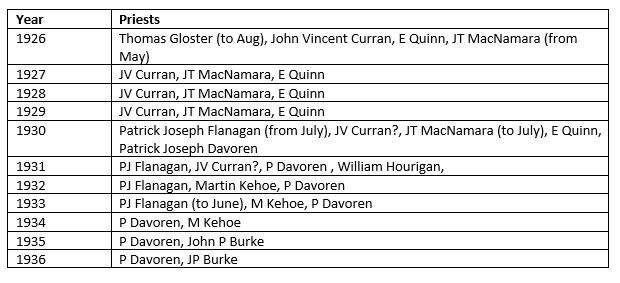
The child was actually fathered by the local Catholic priest. Gus was aged 18 in 1926 and 28 in 1936, so I have concentrated on those years. Using Trove, Electoral Rolls on Ancestry, and the Official Directory of the Catholic Church in Australia website I was able to compile the table below of which priests were based at Cessnock parish during this time. Nobody alive can be sure about which priest (if any) is the baby's father, but hopefully if one of that child's descendants is ever curious they'll have some information to start working from. Obviously, this child and their descendants won't show up in my DNA matches. In case their family story is this Gus was their father, I have added a comment to Gus' public profile in Ancestry to state otherwise.


I don't know that Gus ever told any of his five sisters about this, but he did tell his brother. I know that women keep their own secrets within a family, for example, that somebody "had to get married", that someone else went away for a few months to stay with an aunty and came back thinner than they left, and stories like that. Hearing this story from Monica made me wonder if there are certain stories that are only passed around by the men in a family. 

What do you think? Do you have any family stories that are particularly gendered?


Saturday, 5 March 2022

Why original documents are best

My great-great-grandfather was Henry Burgess GIBB. He was born in Paddington (an inner-city suburb of Sydney) in 1864, and died near Teralba, near Lake Macquarie, New South Wales in November 1901. He died in his tent as he worked as part of the unemployed relief works at the railway. The coroner suggested that his fatal wound was self-inflicted, which is sad to read, especially about a relative. Henry had a letter from his father, John GIBB, on him when he died, so thankfully he was able to be identified. There are a few newspaper articles outlining the gory details if that's your thing...The Teralba Suicide, Brevities, and Supposed Suicide.

Henry is fascinating to me. He fathered my great-grandfather, Andrew Gibb BARRETT (aka George Andrew BARRETT, and later George Andrew (Andy) COLLINS) who was born in the Sydney Benevolent Asylum in 1885. I've written about Andy here. The baby's mother was Ada BARRETT (nee MORRANT). Her husband, William Joshua BARRETT, was in Goulburn Gaol for the attempted murder of their infant son, William James BARRETT. During his incarceration, Ada has had a relationship (of sorts) with Henry. Did Henry know about baby George/Andrew? Henry didn't marry or have any other children that I could find records for. Did Henry's family know about this baby that was fostered into the COLLINS family at Wallsend, New South Wales? Thankfully, a paper trail left by the Sydney Benevolent Asylum named Henry as the father, and Ancestry DNA has since proven this to be true.
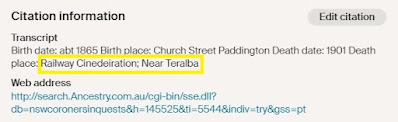
Ancestry has the Registers of Coroners' Inquests and Magisterial Inquiries, 1834-1942 in its database, and this dataset popped up as a hint about the death of my Henry. 


The transcription has the place of death as the Railway Cinedeiration; Near Teralba. Without looking at the original I presumed that Cinedeiration was a specific but obscure railway term that I might one day find out the meaning of. One night I was Googling for the meaning and found nothing. I was about to look for a railway enthusiasts group to enquire with when I thought I should have a look at the original in case they wanted to see a copy of it. 


What was obvious when I saw the original was that the place of death was actually the Railway line deviations, which makes a lot more sense! No need to hunt down a railway group, and look silly in the process. This is why it's important to view the original record rather than rely on a transcription.

I've since edited Ancestry's transcription, to make the record more easily readable for future researchers. 


Friday, 3 January 2020

Accentuate the Positive Geneameme 2019, as prompted by Jill from GeniAus

Thanks to Jill from GeniAus for kicking us off in 2020 with her Accentuate the Positive Geneameme 2019.

1.  An elusive ancestor I found was Les Snider, a half-brother to my grandfather, George Millard Kerville. I only found him because the boy's mother, Marion Snider, was advertising in the Melbourne newspapers for my great-grandfather, Leo Brenell Gabriel, to claim child maintenance from him. The poor little mite died at six weeks, only two weeks after the Police Gazette entry. He was admitted to the Receiving Depot for Neglected Children at Brunswick, Victoria. Very sad.

2.  A great newspaper article I found was in the Kyneton Observer in 1875, where my great-great-grandmother, Elizabeth Ambrose, was sent to gaol for 14 days for house-breaking and larceny. She was 16 years of age at the time. More research required!

3.  A geneajourney I took was all the way to London for my first RootsTech!

4.  I located an important record: rates assessment notices for a property my 4G-aunt, Helen Brownlow Dixon Cruckshank, used as a boarding house in Macquarie Street Sydney in the late 1800s. I'm writing her biography at the moment. I say at the moment, but it's been five years in the pipeline. I'm determined to have it finished by the middle of January when my three-year university course starts.

5.  A newly found family member, Marilyn, shared information on her ancestor, who is a brother to my ancestor. Then I was lucky enough to meet up with her at DNA Down Under in Sydney in August. Another newly found cousin was Penny, a descendant of convict Esther, from England but living in Finland. She flew to London to meet me, which was fabulous. Also Bella, another one of Esther's descendants. She lives in England and we spent my last day there visiting some churches as well as Bevis Marks Synagogue.

6.  A geneasurprise I received was a distant DNA match with genealogy & Facebook friend Maureen.

7.   My 2019 social media post that I was particularly proud of was consolidating many years of research and speculation into a blog post about the 16 children of my ancestor, Esther Salamon Spencer.

8.   I made a new genimate who lives nearby, Regina. We met up prior to travelling to London. Before our lunch date I thought "Do I really have time for this?", but when we did meet we had a million things in common & I'm so glad I made the time.

9.  A new piece of technology or skill I mastered was DNA painting, thanks to Jonny Perl's website.

10. I joined the crowd of Aussies going to RootsTech, along with my 3rd cousin Cheryl. We had a fantastic time.

11. A genealogy education session or event from which I learned something new was RootsTech London!! What an amazing experience in so many ways.

12. A blog post that taught me something new was: all the posts written by State Archives, the National Archives of Australia, The National Archives UK, etc. I love seeing what's new, and the tips they provide.

13. A DNA discovery I made was visual phasing, thanks to Blaine Bettinger at DNA Down Under in August, although it will take some more practice before I'm proficient.

14. I taught a genimate how to interpret their father's y-DNA results

15. A brick wall I demolished was figuring out all of Esther's 16 children when there were only 13 that we could account for up to now (see #7)

16. A great site I visited was (not a website, a real site) 3 churches and a Synagogue in London where some of my ancestors were baptised. Seeing Stonehenge and St George's Chapel at Windsor Castle was pretty special too.

17. A new genealogy/history book I enjoyed was Nathan Dylan Goodwin's novels, as well as meeting the man himself!

18. It was exciting to finally meet Blaine Bettinger in August at DNA Down Under where I was lucky enough to be an Ambassador.

19. I am excited for 2020 because the NSW state conference is being held fairly close to home, in Newcastle. I'll still stay onsite though, so I can easily join in with the after-hours get-togethers and spend more time with friends who have travelled from further away to be there.

20. Another positive I would like to share is back in March I attended a UTP event at Ryde called Researching Your Irish Ancestors, because I have lots of them. One of the speakers was David Rencher from FamilySearch. He blew me away with the breadth of his knowledge about his subject matter, in all the talks he presented. When I was in London for RootsTech I couldn't get into the talk that I wanted to because it was oversubscribed, so I chose a beginner's FamilySearch talk just because David was the presenter. Although I'm frequently on FamilySearch, I still learned things at this talk. I went to see David at the end to tell him that he was THE best presenter I'd ever heard, & he was gracious about the praise, but I think he was happy to hear it as well.

Wednesday, 11 December 2019

Meeting author Nathan Dylan Goodwin

While at a RootsTech London pre-conference dinner in October I finally got to meet genealogical crime mystery author Nathan Dylan Goodwin, whose books I have written about here. My father is a DNA match with his aunt, and while he has cracked the case and worked out the exact link, I don't recognise any of the family names.


My relative, Barry, lives near the setting of Nathan's books, so he gave me a guided tour of his local area and all of the prominent locations. We visited Rye together, the location of Morton's home, The House With Two Front Doors. It was a dream come true to visit Rye. It's long been on my list of places to visit, and to have Barry as my local tour guide was fantastic.

Barry & I in Rye
What's left of The Asylum, the setting of Nathan's most recent book

What's left of The Asylum, the setting of Nathan's most recent book

Hailsham Anglican Church

Hailsham Library

The Kings Head Cacklebury where Morton & Juliette had their first date

Tuesday, 10 December 2019

History Week at State Archives Kingswood

In September a few friends and I attended a celebration for History Week at State Archives in Kingswood, NSW. This included a tour of their back rooms and kilometres of archival shelving.
The number of stories contained in this shelving is enormous.


Monday, 9 December 2019

Convict bonnet exhibition and book launch for They Sent Me North


Looking back over 2019 it has been a wonderful year for family history, with many conferences attended, my first trip to England for RootsTech London, and the launch of a book I contributed an ancestor biography to.

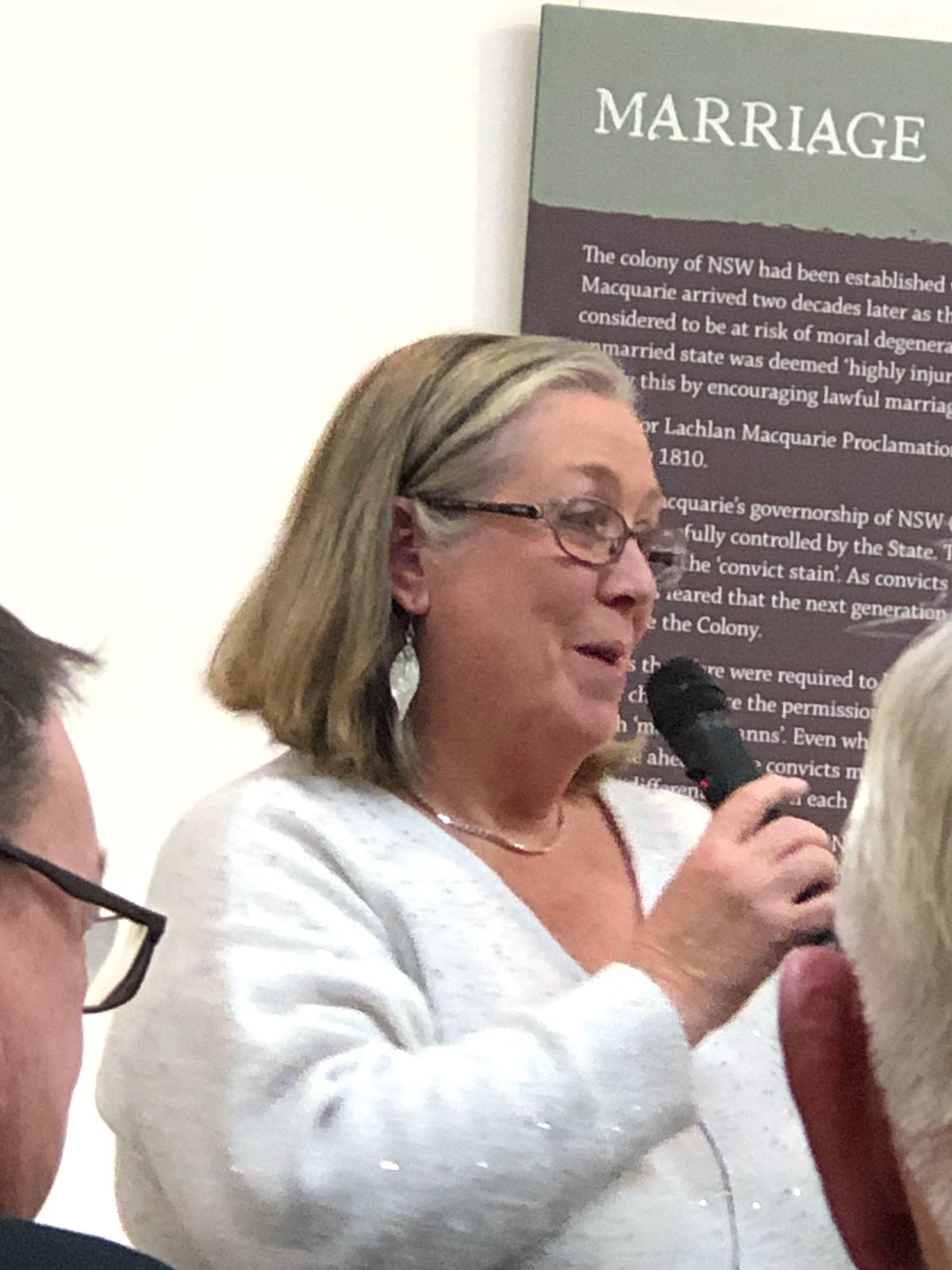
On 30th July, I went with Maria from the Genies Down Under podcast to the Lovett Gallery at Newcastle Library to attend a book launch and Blessing of the Bonnets as part of a worldwide female convict bonnets exhibition. There were over 1000 bonnets on display, lovingly made by a descendant of these convict women, or a volunteer.

Since 2007, Dr Christina Henri has been working on Roses from the Heart, the first ever memorial to the 25,566 women sentenced as convicts and transported to Australia from 1788 to 1853. Roses from the Heart invites people from around the world to make and contribute a servant's bonnet to symbolise the life of each convict woman. The link to Newcastle and the Hunter Region of NSW is a strong one, with many female convicts being sent there from Sydney. My ancestor, Sarah Morris, was one of these women, arriving with her daughter, Jane. Stories about these women and their lives were compiled into a book They Sent me North: Female Convicts in the Hunter. The night was a collaboration between the Newcastle Family History Society, Maitland and Beyond Family History Society, and the Raymond Terrace Historical Society.


Roses from the Heart


Cr Loretta Baker, Mayor of Maitland
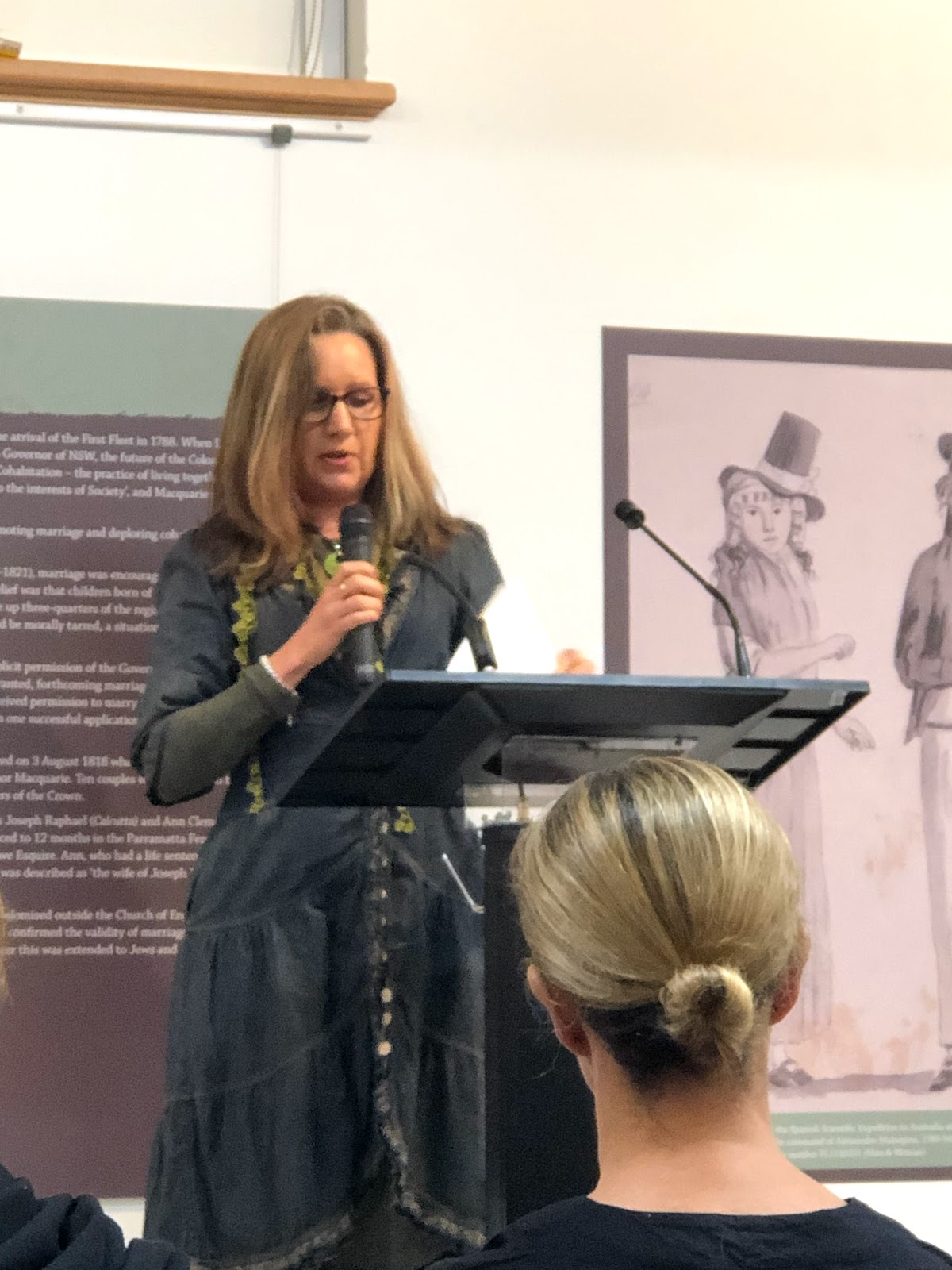
Dr Ann Hardy, University of Newcastle


Left: Jane Ison, Newcastle Family History Society
Centre: Vicki Osborn, Maitland & Beyond Family History Society
Right: Dr Christina Henri, Roses From the Heart project


Melodie Woodford, Newcastle Family History Society

Vicki Osborn, Maitland & Beyond Family History Society

Jane Ison, Newcastle Family History Society
The bonnets were blessed by
Left: Rev Dean Andrew Doohan, Dean of Newcastle Catholic Church
Right: Very Reverend Katherine Bowyer, Dean of Newcastle Anglican Church


My convict's bonnet

My convict's bonnet was sewn by Roma from the Maitland & Beyond Family History Society. A huge thanks to Roma for her talent and generosity. Sarah Morris arrived on the ship Princess Charlotte in 1827. Her two-year-old daughter, Jane, arrived with her, so Roma has included a teddy bear motif around the bonnet to symbolise their shared journey to Sydney. I love that the bonnets were displayed on washing lines, highlighting that washing and laundry tasks were traditionally women's work.